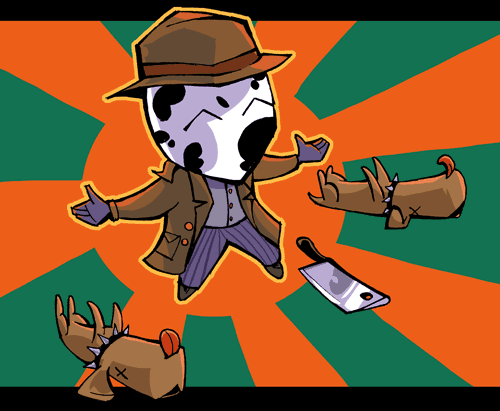
Rorschach is awesome!


This man requires no formal education to know the differences between right and wrong. Rorschach has easily become my favorite character in theWatchmen series. I attribute this to his similarities to DC's Caper Crusader, Batman. Both men operate best when alone, but are also able to perform well working in teams (such as the Minute Men and the Justice League, respectively). Rorschach and Batman tend to lurk within the dark ally ways and use the element of fear to render their enemies helpless. Plus, it is just plain awesome to see both characters beat up cheap punks and delivering tough guy one liners such as, "One-nothing. Your move." Both Walter and Bruce - their alter ego names - also have psychologically damaging experiences growing up, making them vigilantes for justice.

Nearly all of Rorschach's moves are necessary; that also makes him awesome. Nothing about him wastes time or participates in trivial pursuits. If he is not snapping the fingers of a criminal then he remains low key. I attribute his act-when-necessary way of life to his appeal. Most people (particularly males) wish they, too, could behave to the point where nothing they did was a waste. Theoretically, if you were in a bad situation (burning building, bank robbery, etc.) and every action you made had a positive effect and turn the tide, then this makes you a super heroic figure.

Comments

Anonymous said…
Hell Yeah! you said it!

Popular posts from this blog

Understanding Comics Ch. 1-2 & Comic Book Nation Ch.1

To begin with, I really do like the idea of reading a comic about comics. I think it's a great idea and it's very well executed. As I was reading the first two chapters, I was surprised at how many examples there were of art in recent (and ancient, in some cases) history that are variations of "sequential visual art" and thus the foundations of modern comics. I'd never even thought about it before and it was hard to believe how many different kinds there were. I also love all the discussion about how our human brains automatically interpret certain images in a specific way, how we see others constantly but we identify ourselves when we look at cartoons, and how inanimate objects automatically becomes extensions of our bodies. The pyramid of styles was very interesting too as a way to conceptualize and almost graph or "place" a specific art style in comics. In Comic Book Nation , I enjoyed reading about the evolution of early comics from "funnies...

MegaCon 2011 Mobile Blog Entry

Next up, the Crime Noir Panel hosted by The Rack Pack Comic Podcast . Jimmy Palmiotti, Frank Tieri, Darwyn Cook and Dave Johnson are the speakers. MegaCon has matured as the comic industry has grown in importance in popular culture. Orlando's native convention should be attracting this kind of top talents and now it seem to be doing it.

Mythology and Superheroes in Comics

Ohhh my goodness... When I decided on trying to analyze the mythological origins and references in superhero comics, I had no idea the can of worms I was opening up... On the one hand, it was awesome to see just how many connections there were between superheroes and psychology/mythology/philosophy, but all the information also made it terribly difficult to distinguish what I should be using and how to tie it all together. When I was talking to one of my sorority sisters about it she said, "Oh yeah, well, research essays are kind of like putting together puzzles..." and I think that really sums up what writing this paper was like for me. Fortunately, I was really interested throughout the whole process and I very much enjoyed writing the paper. Being a psychology major, I was especially interested in reading about the Jungian archetypes that had a lot of parallels with major modern comic books superheroes. I was also able to incorporate Joseph Campbell's "hero cycle...